Chess
Description
Chess is much more than just a game played on a chessboard. It is a thrilling battle of wits, strategy, patience, and creativity, in which two opponents face off with a common goal: to checkmate the opponent’s king. In every game, every move matters. A seemingly innocent pawn can become the star of the game, while an overly optimistic attack can turn into a disaster in a matter of seconds.
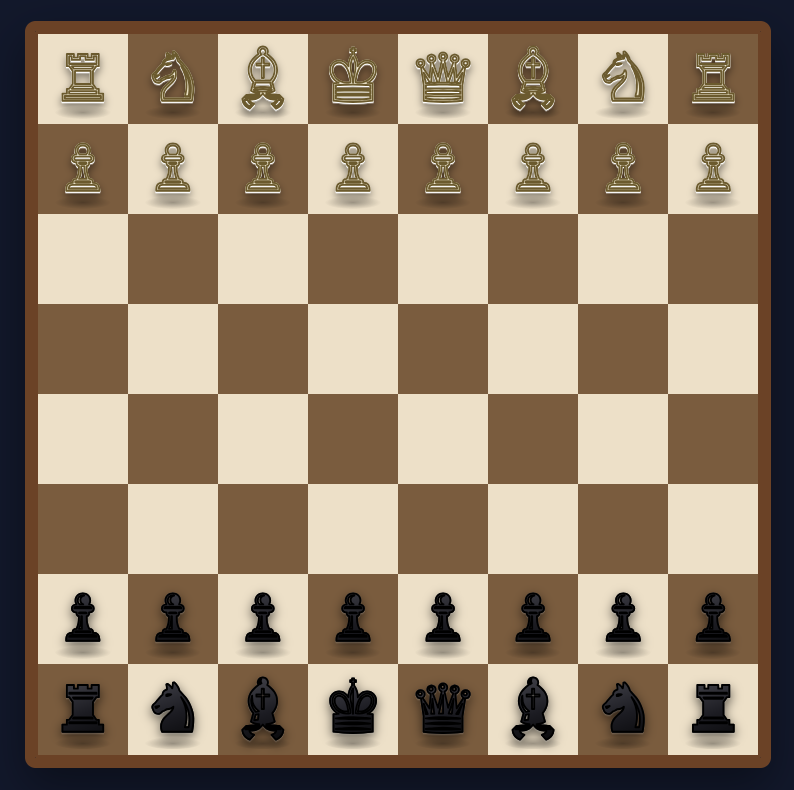
The chessboard consists of 64 squares—32 white and 32 black—arranged in eight rows and eight columns. On either side are the players’ armies: each has a king, a queen, two rooks, two bishops, two knights, and eight pawns. Although the pieces have different movement capabilities, none of them alone is enough to win a game. The real power lies in how they work together.
At the start of the game, the two players are in a seemingly balanced situation. However, the battle begins right from the very first move. The pawns advance toward the center, the knights and pieces are deployed, the queens wait for the right moment, and the kings try to find a safe haven. The first phase of the game is called the opening, and its main objectives are to control the center, develop the pieces, and ensure the king’s safety.
And this is where it gets tricky. Because in chess, it’s not enough to just think about your own move. You also have to think about your opponent’s next move. And then your response to that. And then his response to that. In short, you have to learn to look ahead—far ahead. A good move isn’t necessarily the one that seems impressive. Sometimes the best move is the quietest one—the one that creates a threat without your opponent realizing it.
In the center of the chessboard stands the queen, the most powerful piece in the game. She can move horizontally, vertically, and diagonally, covering enormous distances. However, her power is also a trap: if she enters the fray too early, she can become a target for the opponent’s pieces. Thus, a player must know not only when to attack, but also when to keep their queen safe.
The rook is an extremely powerful piece, especially when the ranks and files open up. The two rooks can work together, occupy open files, and put enormous pressure on the opponent’s king. The bishop moves diagonally and can control long distances. In fact, the two pieces have a special relationship with the color of the squares: one always moves on the white squares and the other always on the black ones.
The knight is perhaps the most unpredictable piece on the chessboard. It moves in a “C” pattern and can jump over other pieces. This makes it extremely useful for surprise attacks and tactical moves. A well-positioned knight can be a real headache for your opponent—especially when it starts attacking multiple pieces at once.
And then there are the pawns. Small, seemingly humble, and often underestimated. But pawns form the foundation of every army. They build defenses, control key squares, open up lines, and can pin down the entire opposing army. Most impressively, a pawn that manages to reach the opponent’s back rank can be promoted, usually to a queen. Thus, the smallest piece on the board can, under the right conditions, become the most powerful.
The king, although the most important piece, is not the strongest. At the beginning of the game, it needs protection, but as the number of pieces dwindles, the king becomes increasingly active. In the endgame, it can participate directly in the battle, protect pawns, and help advance them. It is one of the most interesting paradoxes of chess: the king, who hides at the beginning, comes to the forefront in the endgame.
One of the most distinctive moves is castling. This is a special move in which the king and a rook move together in a single move. Castling allows the king to quickly reach safety while also activating the rook. Of course, like almost everything in chess, it has specific rules and cannot be performed in just any situation.
As the game progresses, we move on to the middle game, where strategy becomes even more complex. This is where tactics come into play: forks, pins, double attacks, attack threats, sacrifices, and traps. A well-calculated sacrifice can turn the entire game around. A player may sacrifice a piece not because they made a mistake, but because they see something the opponent hasn’t yet realized.
And that is one of the magical aspects of chess: a sacrifice does not always mean a loss. It can be an investment. A knight can be sacrificed to open up an attack. A pawn can be given up to buy time. Even the queen can, in exceptional cases, be sacrificed for a combination leading to checkmate. In chess, therefore, the value of a piece is measured not only by how much it “costs,” but also by what it can achieve in a given position.
A game can end in checkmate when the king is in check and there is no legal move to save it. Checkmate is the final moment of the battle. The opponent has no way to escape, and the game ends.
But a chess game doesn't always end in a win. There's also a draw. This can happen in various ways. For example, when a player is not in check but has no legal moves left, we have a stalemate. A draw can also result from a threefold repetition of the same position, by agreement between the two players, or when there is insufficient material to achieve checkmate. If, for example, only two kings remain on the board, neither player can win.
Next comes the endgame, the final phase of the game. At this point, there are usually fewer pieces on the board, but that doesn’t mean the game becomes any simpler. On the contrary, every pawn can be decisive. The player must know how to advance their pawns, how to use their king, and how to turn a small advantage into a win.
Chess, therefore, is a game in which strategy and tactics work together. Strategy concerns the overall plan: which pieces you want to develop, which part of the board you want to control, and how you will create long-term threats. Tactics concern the immediate: what you can gain right now, which piece is unprotected, and whether there’s a move that immediately changes the position.
The best part, though, is that every game has its own story. It might start off calmly and, within a few moves, turn into a fierce attack. A player might find themselves with fewer pieces but still launch a dangerous attack. A seemingly lost position might be saved by an incredible defensive move. And, of course, a player may feel they’ve won… until a humble pawn appears out of nowhere and cries out, “Promotion!”
Chess is also a game of continuous learning. There’s really no point at which someone can say they’ve “learned it all.” There are countless openings, strategies, endgames, and tactical patterns. Every game can reveal a new mistake, a new idea, or a different way of thinking.
Above all, chess teaches players to think before they act. To consider the consequences, recognize risks, devise plans, and adapt when things don’t go as expected. And perhaps that is its greatest appeal: you don’t need luck to win. You need a plan, patience, imagination, and the ability to look a little further ahead than just the next move.
So, behind 64 squares and 32 pieces lies an entire world. A world in which kings are in danger, queens attack, rooks dominate the open files, knights appear from unexpected places, and pawns dream of reaching the far side of the board.
Chess isn't just a game. It's a battle where your mind is your weapon, and every move writes the next page of history.
Up to 2 players can play this game.
New Game
Enter your name and create a room. You'll receive a link to send to your opponent, or you can play against the computer.
Loading room…
Participation in the game
The room is full
The player is already playing with someone else. Create your own room to play in.
New RoomThe call for applications has closed
The player who sent it to you has left, or the invitation is no longer valid.
New RoomThe opponent walked into the room!
The game starts in …
What will the pawn be promoted to?
Quitting the game?
Your opponent will win immediately. This action cannot be undone.